

A Gorilla Photography Settings Guide is one of the most valuable resources any wildlife photographer can have before trekking through Uganda’s ancient rainforests. Photographing endangered mountain gorillas is unlike photographing wildlife in the open savannah. Inside the dense forests of Bwindi Impenetrable National Park and Mgahinga Gorilla National Park, photographers must contend with low light, high humidity, constantly changing weather, and subjects that move naturally through thick vegetation. Success depends not only on creativity but also on understanding the right camera settings before entering the forest.
Uganda has earned its reputation as the world’s premier destination for mountain gorilla photography because it protects more than half of the global mountain gorilla population. Every year, photographers travel from around the world to experience gorilla trekking and the exclusive Gorilla Habituation Experience. Beyond gorillas, Uganda also offers chimpanzee photography in Kibale Forest National Park, classic safari photography in Queen Elizabeth National Park and Murchison Falls National Park, and exceptional bird photography throughout its diverse ecosystems.
While many visitors focus on choosing the best camera or lens, experienced wildlife photographers understand that camera settings often determine whether an image succeeds or fails. The rainforest changes from one minute to the next. A silverback may emerge briefly into a shaft of sunlight before disappearing back into dense foliage. Juveniles may suddenly begin playing, while mothers quietly groom their infants in heavily shaded vegetation. Therefore, photographers who understand exposure, autofocus, shutter speed, aperture, and ISO consistently return with stronger images.
Having spent time photographing and observing mountain gorillas alongside Uganda Wildlife Authority ranger guides and experienced trackers, one lesson becomes immediately clear. Preparation before the trek matters far more than making adjustments once the gorillas appear.
Why This Gorilla Photography Settings Guide Matters for Uganda Treks
Unlike photographing elephants or giraffes on the savannah, mountain gorillas live beneath one of Africa’s oldest rainforest canopies. The dense vegetation blocks much of the available sunlight throughout the day.
Consequently, photographers frequently work in lighting conditions that resemble early evening even during midday. Cameras that perform exceptionally well in low light become invaluable, while photographers must constantly balance shutter speed, aperture, and ISO.
Furthermore, gorillas move unpredictably. A silverback may sit quietly for several minutes before standing suddenly, while young gorillas leap through vines without warning. Therefore, fast autofocus and carefully selected shutter speeds become essential for maintaining image sharpness.
Humidity adds another layer of complexity. Condensation can affect lenses, and rapidly changing weather may require photographers to adapt their settings several times during a single encounter.
Understanding these challenges before your trek significantly improves your chances of capturing memorable wildlife images.
My Experience Photographing Gorillas in Bwindi
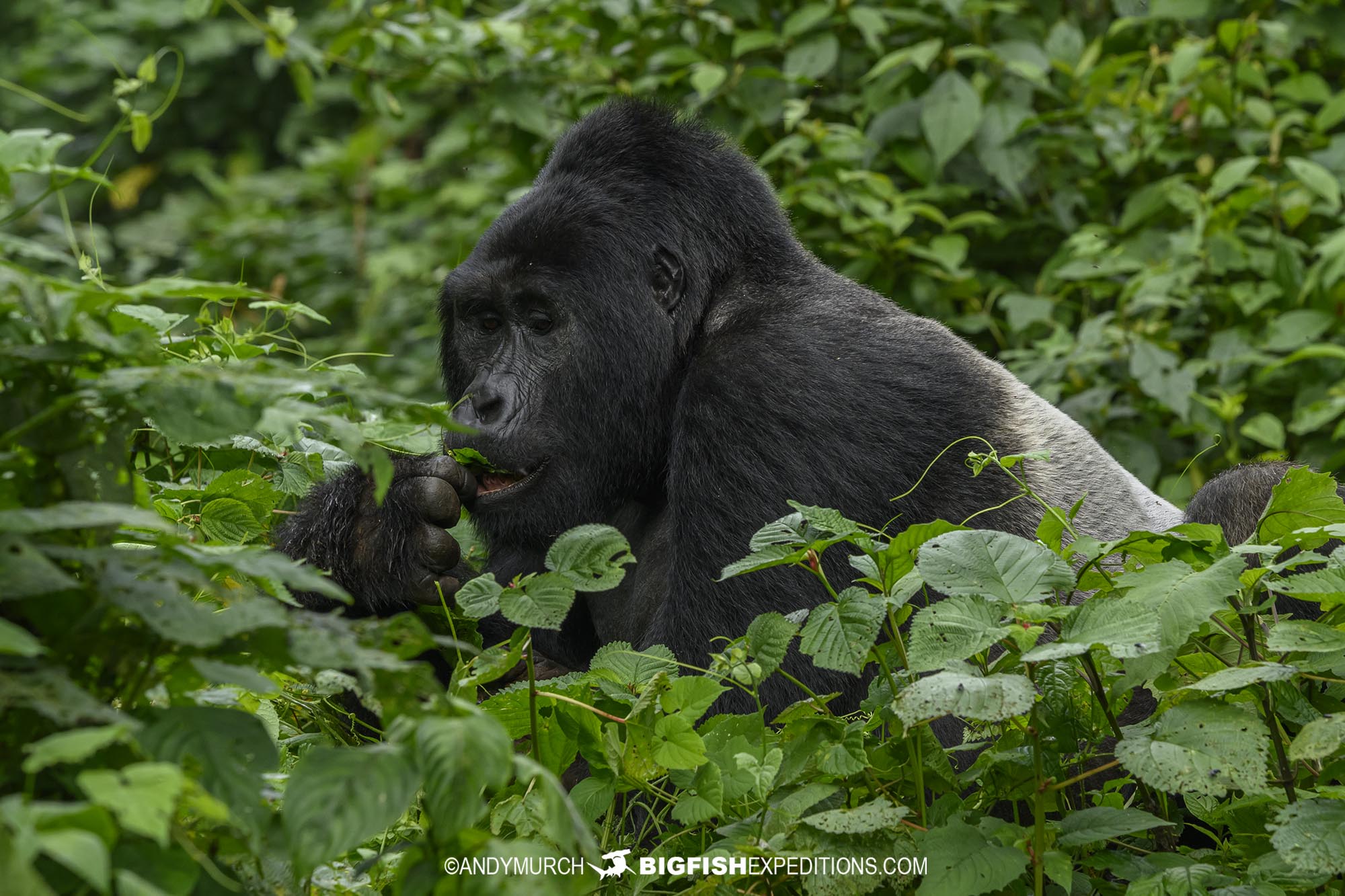
During a morning trek in the Ruhija sector of Bwindi Impenetrable National Park, dense mist settled across the forest after overnight rainfall. The trail remained damp, and the thick canopy allowed very little sunlight to reach the ground.
After several hours of hiking, trackers located a gorilla family feeding on wild celery and bamboo shoots along a steep hillside. The silverback rested beneath hanging vines while two juveniles climbed nearby vegetation.
Initially, I used a conservative ISO because I expected brighter conditions. However, after reviewing my first images, I quickly realised the shutter speed was too slow to freeze movement. Increasing the ISO immediately improved exposure while maintaining a fast enough shutter speed to capture sharp images.
Later in the encounter, sunlight briefly filtered through the canopy and illuminated the silverback’s face. Rather than changing multiple settings, I adjusted exposure compensation and continued photographing. Those few moments produced some of the strongest portraits of the day.
The experience reinforced an important principle of gorilla photography: preparation allows photographers to respond quickly when the forest presents unexpected opportunities.
Best Gorilla Photography Settings Guide for Mountain Gorilla
Every rainforest encounter differs slightly, yet several settings consistently produce excellent results during gorilla trekking in Uganda.
Recommended Camera Settings
| Photography Situation | ISO | Aperture | Shutter Speed | Focus Mode |
|---|---|---|---|---|
| Dense Forest | 1600–3200 | f/2.8–f/4 | 1/500 sec | Continuous AF |
| Silverback Portrait | 2000–3200 | f/4 | 1/400 sec | Eye or Subject AF |
| Juvenile Movement | 2500–4000 | f/4 | 1/1000 sec | Continuous AF |
| Gorilla Family Group | 1600–3200 | f/5.6 | 1/500 sec | Wide AF Area |
| Forest Landscapes | 100–400 | f/8 | Variable | Single AF |
These settings provide a reliable starting point. Nevertheless, photographers should adjust them according to available light and gorilla behaviour throughout the trek.
Gorilla Photography ISO Settings Guide for Uganda’s Rainforests
Many photographers hesitate to increase ISO because they fear digital noise. However, modern cameras perform remarkably well at higher ISO values.
Inside Bwindi’s rainforest, maintaining a sufficiently fast shutter speed often proves more important than using the lowest possible ISO. Consequently, photographers should not hesitate to work between ISO 1600 and ISO 3200 when conditions demand it.
A sharp image with moderate noise almost always outperforms a blurred image captured at a lower ISO.
Best Aperture Settings in This Gorilla Photography Settings Guide
A wide aperture allows more light to reach the camera sensor, making it particularly useful beneath the rainforest canopy.
Portraits of silverbacks often benefit from apertures between f/2.8 and f/4 because they separate the subject from the busy forest background.
Conversely, family interactions sometimes require slightly narrower apertures to maintain sharpness across multiple gorillas within the frame.
Understanding when to prioritise depth of field significantly improves storytelling images.
Best Shutter Speed Settings for Gorilla Photography
Shutter speed determines whether movement appears sharp or blurred.
Mountain gorillas frequently remain calm, yet they can move unexpectedly. Consequently, shutter speeds around 1/500 second provide an excellent balance between sharpness and available light.
For energetic juveniles climbing trees or playing together, photographers often benefit from speeds closer to 1/1000 second.
Autofocus Settings That Improve Success
Reliable autofocus becomes one of the most important features during gorilla trekking.
Continuous autofocus allows cameras to track subtle movement while photographers compose their images.
When available, subject detection or eye autofocus can improve portrait sharpness. However, dense vegetation occasionally confuses autofocus systems. Therefore, photographers should remain comfortable selecting focus points manually when necessary.
Practising autofocus controls before arriving in Uganda greatly reduces stress during the trek.
Best Camera and Lens Combinations
Although many cameras perform well, the combination of camera body and lens often determines the overall photography experience.
| Equipment | Recommendation | Why It Works |
| Weather-Sealed Mirrorless Camera | Highly Recommended | Excellent autofocus and low-light performance |
| Professional DSLR | Highly Recommended | Reliable battery life and durable construction |
| 70–200mm Lens | Excellent Choice | Versatile for portraits and environmental compositions |
| 100–400mm Lens | Very Good | Greater reach when gorillas remain farther away |
| Wide-Angle Lens | Useful | Captures rainforest habitat and storytelling scenes |
The most effective equipment is the gear you know well before your trek begins.
Gorilla Trekking Permit Information
Every visitor photographing mountain gorillas in Uganda must hold a valid permit issued by the Uganda Wildlife Authority.
Permit fees support gorilla conservation, veterinary care, anti-poaching operations, scientific research, ranger training, and community development surrounding protected areas.
Gorilla Permit Cost Comparison
| Experience | Time with Gorillas | Permit Cost (USD) |
| Gorilla Trekking | 1 Hour | 800 |
| Gorilla Habituation Experience | 4 Hours | 1,500 |
The Gorilla Habituation Experience offers photographers substantially more time to document behaviour, changing light conditions, and family interactions.
Bwindi Trekking Sector Analysis for Photography
Each sector within Bwindi Impenetrable National Park provides a distinct photographic experience.
Buhoma Sector Gorilla Photography Settings Guide
Buhoma combines accessible trails with mature rainforest. The balance between manageable trekking and excellent gorilla encounters makes it popular among photographers.
Ruhija Gorilla Photography Settings Guide
Ruhija sits at higher elevations where mist frequently enhances rainforest photography. Soft morning light creates exceptional portrait opportunities.
Rushaga Gorilla Photography Settings Guide
Rushaga hosts numerous habituated gorilla families and the Gorilla Habituation Experience. Consequently, it remains the preferred sector for photographers seeking the longest encounters.
Nkuringo Gorilla Photography Settings Guide
Nkuringo rewards physically prepared visitors with dramatic scenery and unique environmental photography opportunities.
Gorilla Photography Sector Comparison
| Sector | Photography Quality | Landscape Scenery | Gorilla Family Availability | Trek Difficulty |
| Buhoma | Excellent | Excellent | Very Good | Moderate |
| Ruhija | Outstanding | Outstanding | Excellent | Moderate |
| Rushaga | Exceptional | Excellent | Outstanding | Moderate |
| Nkuringo | Exceptional | Exceptional | Excellent | Challenging |
Uganda National Park Photography Experience
Many photographers extend their gorilla safari to experience Uganda’s diverse wildlife.
| National Park | Main Photography Experience | Estimated Safari Cost (USD) | Photography Rating |
| Bwindi Impenetrable National Park | Mountain Gorillas | 1,500–5,500 | Exceptional |
| Mgahinga Gorilla National Park | Gorillas and Volcanoes | 1,200–4,500 | Excellent |
| Kibale Forest National Park | Chimpanzees | 800–3,000 | Excellent |
| Queen Elizabeth National Park | Lions, Elephants and Birds | 700–3,500 | Outstanding |
| Murchison Falls National Park | Big Game and Landscapes | 900–4,000 | Outstanding |
Avoiding Common Camera Setting Mistakes
Many photographers enter the rainforest using fully automatic settings. While automatic modes perform well in some situations, they often struggle with the constantly changing light beneath the canopy.
Another common mistake involves choosing shutter speeds that are too slow. Even subtle gorilla movements can produce blurred images.
Similarly, photographers sometimes avoid increasing ISO unnecessarily. Modern cameras manage higher ISO remarkably well, making image sharpness a higher priority than minimal noise.
Finally, repeatedly reviewing images during the encounter can cause photographers to miss important behavioural moments. Remaining attentive to the gorillas usually leads to stronger storytelling photographs.
Ethical Gorilla Photography Tips and Camera Settings Guide
Great wildlife photography begins with respect for wildlife.
Visitors should always follow ranger instructions, maintain the required viewing distance, avoid flash photography, and minimise unnecessary movement around gorillas.
Ethical behaviour not only protects endangered mountain gorillas but also creates calmer conditions that often improve photographic opportunities.
Responsible photographers help preserve these extraordinary encounters for future generations.
Conclusion
Mastering the correct camera settings transforms gorilla trekking from a memorable wildlife encounter into an exceptional photography experience. Indeed, Uganda’s rainforests present unique technical challenges; however, they also provide extraordinary opportunities to photograph one of the world’s rarest primates in its natural habitat.
Furthermore, by understanding ISO, shutter speed, aperture, autofocus, and the changing conditions within Bwindi Impenetrable National Park and Mgahinga Gorilla National Park, photographers dramatically increase their chances of returning home with compelling wildlife images.
Whether you are joining a standard gorilla trek or the extended Gorilla Habituation Experience, thoughtful preparation, ethical photography, and patience remain the foundations of successful gorilla photography. Moreover, when combined with Uganda’s remarkable biodiversity and world-renowned conservation efforts, these techniques help photographers create images that capture both the beauty of mountain gorillas and the importance of protecting their fragile rainforest home.
Ultimately, successful gorilla photography depends on preparation, adaptability, and respect for wildlife. As a result, photographers who apply these principles often return home with stronger images and unforgettable experiences.
Frequently Asked Questions
What are the best camera settings for gorilla photography?
A good starting point is ISO 1600–3200, an aperture between f/2.8 and f/4, and a shutter speed of around 1/500 second. However, photographers should adjust these settings as light conditions and gorilla behaviour change throughout the trek.
Which autofocus mode works best during gorilla trekking?
Continuous autofocus with subject or eye detection, when available, provides the best results for moving gorillas. In addition, this mode helps photographers maintain sharp focus when animals move unexpectedly through dense vegetation.
Is Gorilla Habituation better for photography than standard trekking?
Yes. In fact, the four-hour Gorilla Habituation Experience offers significantly more opportunities to capture behaviour, changing light, and unique interactions. Consequently, many wildlife photographers prefer it over standard gorilla trekking.
Do I need a permit to photograph mountain gorillas in Uganda?
Yes. Before visiting the gorillas, every visitor must obtain either a Gorilla Trekking Permit or a Gorilla Habituation Experience Permit through the Uganda Wildlife Authority.
Which Bwindi sector offers the best photography opportunities?
Rushaga is widely regarded as the top choice because it has several habituated gorilla families and hosts the Gorilla Habituation Experience. Meanwhile, Ruhija excels for atmospheric mist and dramatic rainforest landscapes. Therefore, the best sector depends on your photography goals and preferred shooting conditions.


