
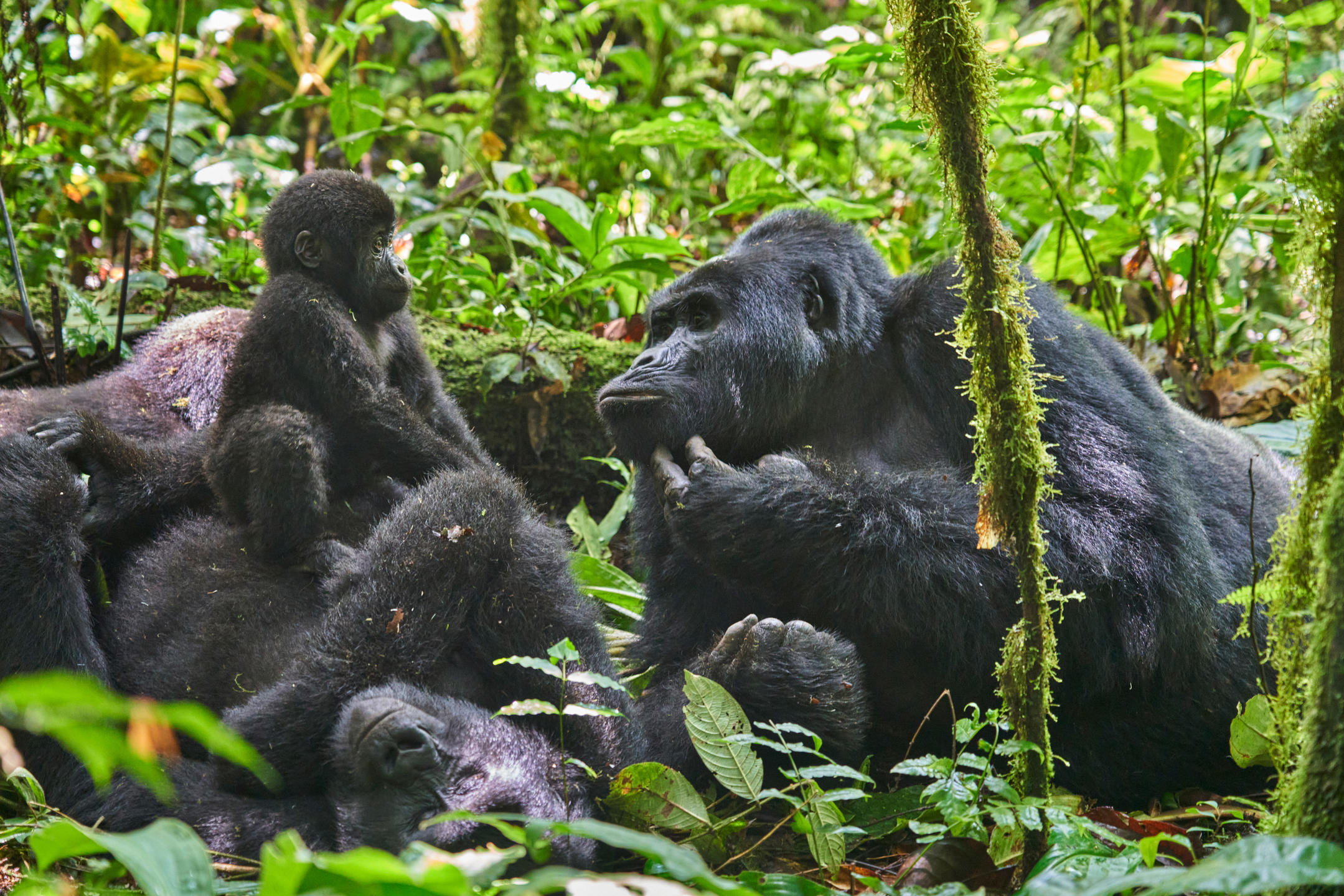
Gorilla trekking Uganda vs Rwanda is one of the most important comparisons for travelers planning a mountain gorilla safari in East Africa. Both countries offer extraordinary encounters with endangered mountain gorillas, but the experience differs in price, accessibility, trekking environment, accommodation, safari options and overall travel style.
So, which is better for gorilla trekking: Uganda or Rwanda?
For most travelers seeking better value, a longer Uganda safari and more choice of trekking sectors, Uganda is the stronger option. Rwanda, however, can be better for travelers who prioritize shorter transfers, a compact itinerary, high-end accommodation and convenient access from Kigali.
The important point is that neither country offers a universally better gorilla experience. Both protect mountain gorillas within the same broader conservation landscape, and both provide carefully regulated encounters with habituated gorilla families.
The right choice depends on what matters most to you.
Uganda offers gorilla trekking in Bwindi Impenetrable National Park and Mgahinga Gorilla National Park, while Rwanda offers trekking in Volcanoes National Park. Uganda’s Bwindi contains several trekking sectors, giving travelers more geographic and itinerary choices. Rwanda concentrates its gorilla experience around the Volcanoes region, making it particularly convenient for a short trip from Kigali.
Uganda vs Rwanda Gorilla Trekking at a Glance
If your main concern is value, Uganda has a significant advantage. Rwanda currently charges US$1,500 per person per day for a standard gorilla permit for international visitors. Uganda’s most recently published UWA tariff for July 2024–June 2026 listed the foreign non-resident gorilla permit at US$800, although travelers booking in 2026 should confirm the new UWA tariff before paying.
The difference becomes even more important when you consider the complete safari.
Uganda gives you the opportunity to combine gorilla trekking with chimpanzee tracking in Kibale Forest, wildlife viewing in Queen Elizabeth National Park, boat safaris, Murchison Falls, Kidepo Valley, cultural experiences and other destinations.
Rwanda provides a much more compact experience. Volcanoes National Park sits relatively close to Kigali, and the country’s excellent road network makes it possible to build a short gorilla-focused trip without spending several days driving between destinations. Visit Rwanda describes the gorilla experience as relatively accessible, with treks beginning from the Volcanoes region and hiking times varying according to the location of the assigned gorilla group.
Therefore, Uganda tends to win on value and safari variety, while Rwanda often wins on convenience and compact luxury travel.
Where Can You See Gorillas in Uganda and Rwanda?
Understanding the destinations is the first step in making the comparison.
In Uganda, mountain gorilla trekking takes place in Bwindi Impenetrable National Park and Mgahinga Gorilla National Park.
Bwindi is the country’s principal gorilla destination. UWA identifies four main trekking sectors: Buhoma, Ruhija, Rushaga and Nkuringo. The park is home to roughly half of the world’s mountain gorilla population, according to UWA.
Mgahinga offers a different experience. It lies within the Virunga Mountains and protects Uganda’s side of the volcanic range shared with Rwanda and the Democratic Republic of Congo. UWA describes Mgahinga as Uganda’s smallest national park and notes that it has one habituated transboundary gorilla group.
Rwanda’s gorilla trekking takes place in Volcanoes National Park, part of the Virunga Massif.
Visit Rwanda currently states that twelve gorilla families live in Volcanoes National Park and that each tourist group spends a maximum of one hour with the gorillas. It also states that eight tracking permits are issued per troop per day, creating a highly regulated visitor experience.
This creates an important difference.
Uganda gives you more trekking sector choices, while Rwanda gives you a highly concentrated gorilla experience around the Volcanoes.
Gorilla Trekking Uganda vs Rwanda: Which Is Cheaper?

For international travelers, Uganda generally provides better value.
Rwanda’s official tourism website currently lists the gorilla trekking permit at US$1,500 per person per day. Rwanda also offers special rates for certain Rwandan and East African Community categories, subject to the applicable terms.
Uganda’s published UWA tariff for July 2024–June 2026 listed a foreign non-resident gorilla permit at US$800, with lower rates for foreign residents and East African citizens. The same tariff listed the Gorilla Habituation Experience at US$1,500 for foreign non-residents.
However, because that Ugandan tariff ended in June 2026, you should not publish US$800 as an unquestioned current 2026 price without checking the latest UWA tariff. UWA’s current rates page indicates that a 2026–2027 tariff change document exists, so Ababa Uganda Safaris should verify the live figure before updating the article.
Even when permit prices change, Uganda’s value proposition remains important because the country allows travelers to build longer safari itineraries around the gorilla experience.
A traveler can spend several days experiencing primates and wildlife rather than flying or driving into Rwanda solely for a gorilla trek.
That makes Uganda particularly attractive to travelers who want a complete East African safari rather than a short gorilla holiday.
Is Gorilla Trekking Better in Uganda or Rwanda?
The answer depends on what you mean by “better.”
If you mean better value, Uganda has the advantage.
For easier access, Rwanda has the advantage.
Choices of trekking sectors, Uganda has the advantage.
Compact luxury trip, Rwanda has a strong advantage.
If you mean combining gorillas with chimpanzees and classic wildlife, Uganda is difficult to beat.
Shortest possible gorilla-focused itinerary from an international airport, Rwanda is often the more convenient choice.
The actual gorilla encounter itself can be extraordinary in either country.
Mountain gorillas do not become more impressive simply because you cross an international border.
What changes is the journey required to reach them and the wider safari experience surrounding the trek.
Uganda Gorilla Trekking vs Rwanda: The Trekking Experience

Gorilla trekking in both countries involves hiking through mountainous forest to locate a habituated gorilla family.
The hike can vary considerably from one day to another.
UWA states that gorilla treks in Uganda can last approximately two to seven hours, depending on the location of the gorilla family. Once the group is located, visitors receive one hour of observation.
Rwanda’s official tourism information similarly explains that hikes can range from around 30 minutes to four or more hours, depending on the location of the assigned family, with elevations reaching approximately 2,500 to 4,000 metres.
This means travelers should avoid assuming that Rwanda always provides an “easy” trek.
Rwanda can offer relatively accessible trekking because Volcanoes National Park lies close to the park headquarters and Kigali. However, the actual hike can still become strenuous because the Virunga volcanoes rise to high elevations.
Uganda can also provide shorter treks on certain days.
The key factor is the location of the assigned gorilla family.
Therefore, anyone selling Uganda as “hard” and Rwanda as “easy” oversimplifies the reality.
Uganda vs Rwanda: Which Has Better Gorilla Trekking Scenery?
This comparison becomes subjective because both countries offer spectacular mountain landscapes.
Rwanda’s Volcanoes National Park is famous for its dramatic volcanic scenery. The Virunga volcanoes create an unmistakable backdrop, while bamboo forests and high-altitude vegetation contribute to the distinctive landscape.
Uganda’s Bwindi offers a very different atmosphere.
Instead of focusing primarily on volcanic slopes, Bwindi surrounds visitors with dense ancient rainforest, steep ridges, tangled vegetation and mist-covered hills.
This difference can influence your choice.
If you dream of trekking through dense, mysterious rainforest, Uganda’s Bwindi may appeal more strongly.
If you prefer volcanic landscapes and open mountain vistas, Rwanda’s Volcanoes region can be especially attractive.
Neither landscape is objectively better.
They simply create different visual experiences.
Which Country Has More Gorilla Trekking Options?
Uganda wins this category.
Bwindi has four principal trekking sectors: Buhoma, Ruhija, Rushaga and Nkuringo, while Mgahinga provides another trekking destination. UWA’s gorilla management guidelines identify the designated Ugandan entry points as Buhoma, Ruhija, Nkuringo, Rushaga and Ntebeko/Muhavura for Mgahinga.
This matters because your choice of sector can affect the entire safari.
The location of your lodge, driving time, scenery and post-trek itinerary all depend on the sector.
Rwanda’s gorilla trekking is more concentrated around Volcanoes National Park.
That concentration makes Rwanda easier to navigate, but Uganda’s geographic variety creates more flexibility.
For a specialist safari operator, this also makes Uganda particularly interesting because the itinerary can be tailored around the traveler’s physical ability, accommodation preference and broader safari interests.
Which Country Is Better for Gorilla Trekking Beginners?
Both Uganda and Rwanda can work well for first-time gorilla trekkers.
However, Rwanda may appeal to travelers who want a shorter and simpler trip.
Kigali International Airport provides a convenient starting point, and Volcanoes National Park is relatively close to the capital.
Rwanda’s tourism authority recommends booking in advance and allows visitors to arrange gorilla tracking through licensed tour operators or its online booking system.
Uganda requires more careful itinerary planning because Bwindi and Mgahinga sit farther from Entebbe and Kampala.
That additional travel time can feel like a disadvantage for someone who only wants a two- or three-day gorilla experience.
However, it becomes much less significant when you are planning a seven-, ten- or fourteen-day Uganda safari.
The journey then becomes part of the adventure rather than simply a transfer.
Uganda vs Rwanda for Luxury Gorilla Safaris
Rwanda has built a particularly strong reputation for high-end gorilla tourism.
The country’s compact geography allows luxury travelers to spend less time on long road transfers and more time enjoying premium accommodation and curated experiences.
High-end lodges around Volcanoes National Park can also make Rwanda attractive for travelers seeking an exclusive, polished safari.
Uganda can deliver luxury too, but the experience often feels more expansive.
Luxury travelers can stay in high-end lodges around Bwindi and combine the gorilla experience with private wildlife safaris, chimpanzee tracking and other premium experiences.
The difference is therefore less about whether luxury exists and more about the style of luxury.
Rwanda suits travelers who want compact, polished and convenient luxury.
As for Uganda suits travelers who want luxury combined with a longer, more varied safari.</p>
Uganda vs Rwanda for Budget Tr
avelers
Uganda generally makes more sense for budget-conscious international travelers.
The historical difference in gorilla permit prices creates a major advantage, although travelers must verify the current UWA tariff when booking because the published 2024–2026 tariff has expired.
Uganda also has a broad range of accommodation.
Travelers can choose from budget guesthouses, mid-range lodges and luxury properties around different trekking sectors.
However, you should not confuse a cheaper gorilla permit with a cheaper total holiday.
Uganda involves longer road journeys to many gorilla destinations.
Transportation can therefore increase the total cost of a short trip.
Rwanda’s higher permit price may be offset partially by shorter transfers and the ability to build a compact itinerary.
For that reason, compare the total safari quotation, not just the permit price.
Uganda vs Rwanda for Families
Gorilla trekking requires careful consideration for families because both countries impose age restrictions.
Rwanda’s official tourism information currently states that the minimum age for gorilla tracking is 15 years.
Families should confirm current rules with the relevant tourism authority before booking because regulations can change.
For families with older teenagers, either country can provide an unforgettable experience.
Uganda has another advantage for family itineraries because a gorilla trek can form part of a broader safari that includes wildlife viewing, boat trips, chimpanzee tracking and cultural experiences.
This gives families more variety.
Rwanda can be better if the family wants a shorter itinerary with less time spent driving.
Uganda vs Rwanda for Chimpanzee Tracking
Uganda has a major advantage here.
Kibale National Park is one of the country’s flagship chimpanzee destinations and fits naturally into a primate-focused itinerary.
A traveler can combine chimpanzee tracking in Kibale with gorilla trekking in Bwindi and wildlife viewing in Queen Elizabeth National Park.
That combination creates a powerful primate-and-wildlife safari.
Rwanda also offers chimpanzee tracking in Nyungwe National Park and can combine gorillas with other primate experiences.
Visit Rwanda promotes itineraries that combine Volcanoes National Park with Nyungwe Forest, including chimpanzee tracking and the canopy walkway.
Therefore, both countries work for primate enthusiasts.
Uganda simply provides a particularly strong combination of gorillas, chimpanzees and savannah wildlife.
Uganda vs Rwanda for a Complete Wildlife Safari
This is where Uganda often pulls ahead.
A Uganda itinerary can combine gorilla trekking with Queen Elizabeth National Park, where travelers can experience savannah wildlife and boat cruises, as well as Kibale Forest for chimpanzees.
You can also extend a Uganda safari toward Murchison Falls National Park or Kidepo Valley National Park.
That gives travelers an unusually broad wildlife experience within one country.
Rwanda offers excellent wildlife experiences too.
Akagera National Park provides savannah wildlife and boat safaris, while Nyungwe adds rainforest and primates.
Visit Rwanda promotes combined wildlife and gorilla itineraries that include Akagera and Volcanoes National Park.
Still, if your priority is gorillas plus chimpanzees plus classic East African wildlife, Uganda has an especially compelling itinerary structure.
Uganda vs Rwanda: Which Is Better for a Short Trip?
Rwanda wins.
If you have only three or four days and want your primary objective to be gorilla trekking, Rwanda’s proximity to Kigali makes the trip straightforward.
You can arrive in Kigali, transfer to the Volcanoes region, trek gorillas and return to Kigali without spending a large portion of your holiday on long road transfers.
Visit Rwanda specifically highlights the accessibility of Volcanoes National Park and provides direct booking options for gorilla tracking.
Uganda becomes more attractive when you have enough time to enjoy it.
A three-day Uganda gorilla safari remains possible, but the logistics require more careful planning.
For a week or longer, however, Uganda becomes increasingly compelling because the additional travel time allows you to experience more destinations.
Uganda vs Rwanda: Which Is Better for a Longer Safari?
Uganda has the edge.
A longer Uganda itinerary can connect several ecosystems.
You can begin in Entebbe or Kampala, continue toward Kibale for chimpanzees, travel through Queen Elizabeth National Park for wildlife, and then reach Bwindi for gorilla trekking.
You can also extend the safari beyond this classic route.
This creates a journey rather than a single activity.
Rwanda can also support longer itineraries, particularly when you combine Volcanoes, Nyungwe and Akagera.
However, Uganda’s larger geographic and ecological diversity makes it particularly attractive to travelers who want a broad safari.
Gorilla Habituation: Uganda Has an Important Advantage
One of Uganda’s most significant advantages is the Gorilla Habituation Experience.
The experience differs from standard gorilla trekking because visitors accompany researchers and habituation teams as they work with gorillas that continue to become accustomed to human presence.
UWA’s guidelines distinguish standard gorilla tracking from the Gorilla Habituation Experience.
Under Uganda’s published July 2024–June 2026 tariff, the habituation experience cost US$1,500 for foreign non-residents, compared with US$800 for standard gorilla tracking during that tariff period.
The current tariff should be confirmed before booking.
For serious primate enthusiasts, photographers and travelers who want a longer gorilla experience, this option can be a decisive reason to choose Uganda.
Which Country Offers Better Conservation Value?
Both countries have invested heavily in mountain-gorilla conservation.
Mountain gorillas move across a transboundary ecosystem spanning Uganda, Rwanda and the Democratic Republic of Congo. Conservation therefore requires cooperation across national borders.
Uganda Wildlife Authority continues to work with conservation organizations and regional partners on gorilla monitoring and conservation. UWA’s 2025 Bwindi-Sarambwe gorilla census, for example, involved multiple organizations and regional conservation partners, including the Rwanda Development Board and the Greater Virunga Transboundary Collaboration.
Rwanda also directs tourism revenue toward conservation and local communities.
Visit Rwanda states that ten percent of income from gorilla, safari and other tourism permits and park fees goes toward partnerships with local communities. It also describes compensation mechanisms designed to reduce conflict between gorillas and neighboring farmers.
Therefore, choosing Uganda or Rwanda can support gorilla conservation.
The more important decision is to travel responsibly, follow ranger instructions, respect distance rules and avoid behavior that could stress the animals.
Best Time for Gorilla Trekking in Uganda vs Rwanda
Both countries allow gorilla trekking throughout the year.
The traditional dry seasons tend to attract more visitors because hiking conditions can become easier.
Uganda’s rainforest environment means rain can occur even during the dry season, so travelers should always carry waterproof gear.
Rwanda’s Volcanoes region also experiences changing mountain weather.
The important point is that weather does not determine whether gorillas are present.
The gorillas remain in their habitat throughout the year.
Instead, weather affects the physical conditions of the trek.
If you prioritize easier hiking, the drier months are generally attractive.
If you prefer fewer visitors and do not mind rain, shoulder and wetter seasons can offer rewarding experiences.
Which Has Better Gorilla Trekking Availability?
Availability depends on the travel date, permit allocation and the destination you choose.
Rwanda currently states that eight tracking permits are issued per gorilla troop each day and that it has twelve habituated tourist groups in Volcanoes National Park, resulting in a stated maximum of 96 permits per day.
Uganda operates across multiple sectors and designated entry points.
UWA’s gorilla management guidelines state that permits are booked according to the date and designated entry point, with visitors allocated to specific gorilla family groups on the day of tracking.
This geographic distribution can give Uganda travelers more planning options.
However, you should never assume that a particular gorilla family will be available simply because you request it.
Gorilla movements, permit allocations and operational decisions determine the final trekking arrangement.
Uganda vs Rwanda Gorilla Trekking: Which Is Better for Photography?
Both countries offer excellent photographic opportunities.
Uganda’s Bwindi provides a dense rainforest setting with dramatic vegetation, mist and filtered forest light.
Rwanda’s Volcanoes region can offer striking volcanic scenery and bamboo-covered slopes.
The gorillas themselves remain the main attraction in either destination.
Photography also depends on your equipment, weather, trekking conditions and the behavior of the gorilla family you encounter.
A professional camera does not guarantee better photographs.
Good preparation matters more.
Protect your equipment from rain, carry spare batteries and understand how to photograph in low forest light.
Most importantly, follow the guide’s instructions.
The encounter exists for conservation and education, not simply for photography.
Uganda vs Rwanda Gorilla Trekking: Which Is Safer?
Both destinations operate regulated gorilla tourism under established national park systems.
Visitors trek with trained guides and follow park rules designed to protect both people and gorillas.
Rwanda’s official tourism authority describes gorilla tracking as safe and relatively accessible.
Uganda similarly operates gorilla trekking through UWA-managed protected areas, with designated entry points and official permits.
The more important issue for travelers is not choosing a country because of generalized safety claims.
Instead, choose a licensed operator, follow official travel advice, use experienced guides and plan transportation properly.
Conditions can change, so travelers should always check current travel advisories before departure.
Uganda vs Rwanda Gorilla Trekking: The Real Winner
So, which is better?
For most travelers, Uganda offers the better overall gorilla safari value.
Its combination of Bwindi and Mgahinga, multiple trekking sectors, lower historical permit pricing, gorilla habituation opportunities and the ability to combine gorillas with chimpanzees and major wildlife destinations makes Uganda particularly attractive for a complete safari.
Rwanda becomes the better choice when convenience matters more than price.
If you have only a few days, want a straightforward transfer from Kigali, prefer a compact luxury itinerary or want to focus almost entirely on the gorilla experience, Rwanda can be an excellent choice.
The decision can therefore be summarized simply.
Choose Uganda if you want value, variety, longer safaris, multiple trekking sectors, chimpanzees, wildlife and the option of gorilla habituation.
Choose Rwanda if you want convenience, a short gorilla-focused itinerary, easy access from Kigali and a strong luxury-travel environment.
But there is another important consideration.
Do not choose a country simply because someone tells you that its gorillas are “better.”
The mountain gorillas do not recognize the border between Uganda and Rwanda.
The same broader Virunga ecosystem connects these landscapes, while Bwindi represents another important mountain-gorilla habitat in Uganda. UWA notes that Uganda holds more than half of the world’s remaining mountain gorillas across Bwindi and Mgahinga.
The real difference lies in the journey.
Frequently Asked Questions About Gorilla Trekking Uganda vs Rwanda
Is Uganda or Rwanda better for gorilla trekking?
Uganda is generally better for travelers who prioritize value, a wider safari experience, multiple trekking sectors and gorilla habituation. Rwanda is often better for travelers who prioritize convenience, short itineraries and easy access from Kigali.
Is gorilla trekking cheaper in Uganda or Rwanda?
Uganda has historically offered a substantially lower permit price for foreign non-residents. Rwanda currently lists its standard international gorilla permit at US$1,500 per person per day. Uganda’s published 2024–2026 tariff listed US$800 for foreign non-residents, but travelers should confirm the current UWA tariff for 2026–2027 before booking.
Are Uganda gorillas the same as Rwanda gorillas?
They are the same subspecies of mountain gorilla, but they live in different protected areas within the broader mountain-gorilla ecosystem. The Virunga population crosses Uganda, Rwanda and the Democratic Republic of Congo, while Bwindi contains another major mountain-gorilla population in Uganda.
Is Uganda gorilla trekking harder than Rwanda?
Not necessarily. Both destinations involve mountainous terrain, and trekking difficulty depends heavily on the location of the assigned gorilla family. Uganda’s Bwindi contains steep rainforest terrain, while Rwanda’s Volcanoes National Park reaches high elevations.
Is Rwanda better for first-time gorilla trekkers?
Rwanda can be particularly convenient for first-time visitors because Volcanoes National Park is relatively accessible from Kigali. However, Uganda also provides an excellent first gorilla trekking experience if you allow enough time for transportation and choose your trekking sector carefully.
Which is better for a luxury gorilla safari?
Rwanda is particularly strong for compact luxury gorilla trips because of its accessibility from Kigali and concentration of high-end tourism around Volcanoes National Park. Uganda can be better for travelers who want to combine luxury gorilla trekking with a longer wildlife and primate safari.
Which country is better for budget gorilla trekking?
Uganda generally offers stronger value, particularly when the gorilla trek forms part of a longer safari. However, travelers should compare the entire trip cost because transportation, accommodation and safari duration can influence the final price more than the permit alone.
Can I do gorilla trekking in Uganda and Rwanda on the same trip?
Yes. A cross-border itinerary can combine gorilla trekking in both countries, although this usually makes sense for travelers with sufficient time and a specific reason for experiencing both destinations. Border crossings, permits and transportation require careful planning.
Which country has more gorilla trekking sectors?
Uganda has more designated gorilla trekking sectors. UWA identifies Buhoma, Ruhija, Rushaga and Nkuringo in Bwindi, along with the Ntebeko/Muhavura entry point in Mgahinga.
Which country is better for gorilla habituation?
Uganda has the advantage because it offers the Gorilla Habituation Experience. UWA distinguishes habituation from standard gorilla tracking, with visitors accompanying researchers and habituation teams.
Which country is better for gorillas and chimpanzees?
Uganda is particularly strong because travelers can combine gorilla trekking in Bwindi with chimpanzee tracking in Kibale Forest. Rwanda can also combine gorilla trekking in Volcanoes with chimpanzee experiences in Nyungwe.
Which country is better for gorillas and Big Five wildlife?
Uganda offers an excellent combination because travelers can combine gorilla trekking with wildlife experiences in Queen Elizabeth National Park and other Ugandan parks. Rwanda can also combine gorillas with Akagera National Park, where travelers can experience savannah wildlife.
How long should I spend in Uganda for gorilla trekking?
A gorilla trek can form part of a short itinerary, but a longer trip gives you the opportunity to combine gorillas with chimpanzees, wildlife and cultural experiences. For travelers flying internationally, five to ten days often provides much more value than visiting solely for one trekking day.
How long should I spend in Rwanda for gorilla trekking?
A short three- or four-day Rwanda itinerary can work well if gorilla trekking is your main objective. You can extend the trip by adding cultural experiences, golden monkey trekking, Akagera or Nyungwe.
Can children go gorilla trekking in Uganda or Rwanda?
Age restrictions apply. Rwanda’s official tourism information currently states a minimum age of 15 for gorilla trekking. Travelers should confirm the current age requirements with the relevant authority before booking because regulations can change.
Is gorilla trekking worth the higher price in Rwanda?
For travelers who value convenience and a short, polished itinerary, Rwanda’s higher permit price can make sense. For travelers who want a longer safari and better overall value, Uganda can provide a stronger proposition.
Final Verdict: Uganda or Rwanda?
There is no universal winner.
Uganda is the better choice for most travelers who want value and a complete safari. Rwanda is the better choice for travelers who want convenience and a compact gorilla-focused experience.
If you have time, Uganda gives you the chance to turn gorilla trekking into a much broader East African adventure.
You can experience chimpanzees in Kibale, wildlife in Queen Elizabeth, the forests of Bwindi and the mountain gorillas that make Uganda one of Africa’s most extraordinary safari destinations.
If you have only a few days and want to minimize road travel, Rwanda’s Volcanoes National Park provides an exceptionally convenient route to the gorillas.
Whichever country you choose, book your permit early, use a licensed safari operator and prepare properly for a demanding mountain trek.
The best gorilla safari is not simply the one with the lowest permit price or the shortest transfer.
It is the one that matches your time, budget, fitness, interests and preferred style of travel.
For travelers who want to experience Uganda’s gorillas while also exploring the country’s wildlife, primates, landscapes and culture, a professionally planned Uganda safari can offer exceptional value and depth.


